making music with codex
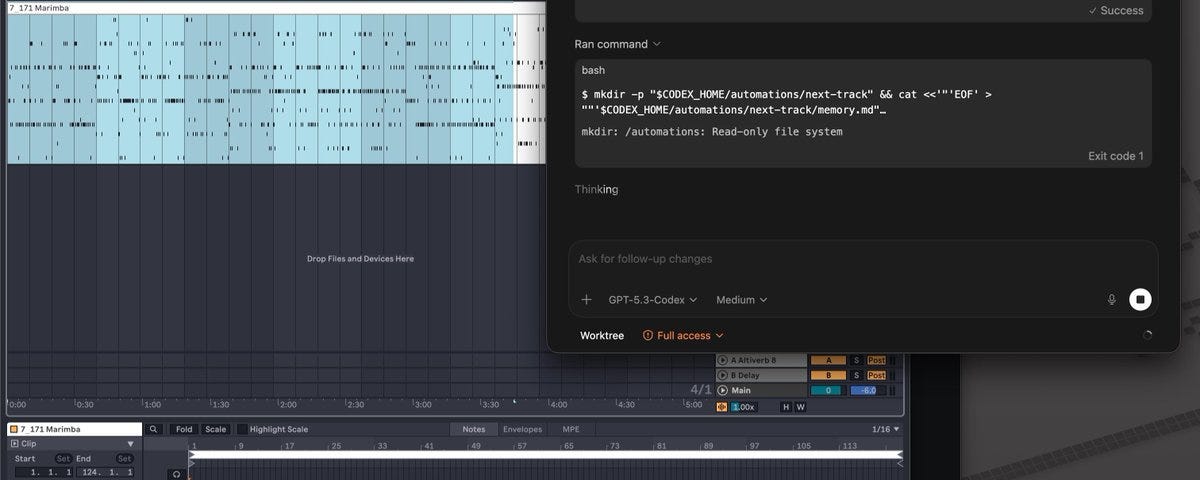
i’m excited to introduce codex-live-bridge (my first open-source project). it’s a local-first codex-to-ableton live control bridge.
started during the openai 2026 hackathon in san francisco, built in tandem with gpt-5.3-codex. it lets the codex app, cli, or ide extension control and compose alongside you in ableton live.
this project includes a max for live device, a javascript command router, and python osc client/cli scripts that drive ableton live through liveapi (the live object model) over osc/udp.
it also utilizes a local memory + eval loop that starts from blank user templates and is filled by each user’s own compositional intent over time.
(this project is independent and is not affiliated with or endorsed by openai, ableton, or cycling ‘74. all trademarks belong to their respective owners.)
here it is in action:
get started right now
- clone repo - https://github.com/sunflower-of-parchman/codex-live-bridge
download ableton live 12 suite 30-day free trial (includes max for live): ableton live trial - download the codex app and sign in with your chatgpt account: codex app
- install python 3.10+: python.org downloads
- live object model reference: cycling ‘74 live object model docs
- in ableton live, drag bridge/m4l/LiveUdpBridge.amxd onto a midi track.
- from repo root, run:
python3 bridge/ableton_udp_bridge.py --ack --status --no-tempo --no-signature
3. confirm you see acks like:
ack:  /ack pong
ack:  /ack status <total_tracks> <midi_tracks> <audio_tracks> <return_tracks> live_set <id>
data & training
- this repo ships no trained model weights.
- this repo does not implement model training or fine-tuning pipelines.
- this project does not train on, copy, or emulate other artists’ catalogs, genres, or styles. it focuses on user-guided, user-owned co-composition, helping the user compose in tandem with the software by working from the user’s own musical material and intent.
- preference and guidance templates in this repo are intentionally blank at clone time; musical direction is user-authored when the user fills those docs with their own context, constraints, and goals.
compositional studio assistant workflow
a template usage pattern in this repo is:
- keep track 1 in ableton live as codex-bridge (control/bridge, no instrument).
- put your first instrument on track 2.
- treat the track-2 instrument as the first instrument in your ensemble.
- if needed, put your second instrument on track 3 and treat it as the second ensemble entry.
- choose meter, bpm, and optional mood/key, then compose with workflow scripts.
- review eval artifacts, adjust constraints/guidance, and compose again.
current eval coverage
when enabled, eval artifacts focus on symbolic composition structure, not rendered audio quality.
current artifact fields include:
- run metadata (mood, key, tempo, meter, minutes, bars, section size, status)
- per-track note-count paths and created-clip counts
- structural fingerprints and a fingerprint hash
- similarity/novelty values against recent reference runs
- repetition flags for repeated trajectories
artifacts are persisted to:
- memory/evals/compositions/<date>/<run_id>.json
- memory/evals/composition_index.json
my hope is to build a self-improving compositional loop - where user-authored preferences and the growing body of work we create together feed into eval, memory, and governance after each piece, and then actively shape the next one. i am seeing shapes of this already within this system, specifically while using skills and hourly intervallic automations within the codex app.
enjoy and have fun. i believe there are many ways that we will interact with artificial intelligence and music systems. i for one am running right towards the ones that search for new music we’ve never heard before.